THE GREATER GAME
A true story of sport and war
The Battle Of Loos September, 1915
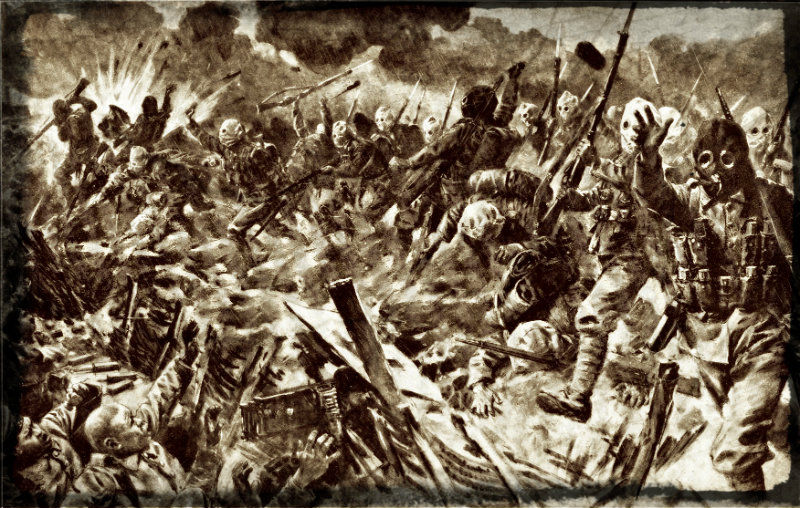
By September 1915 the war with Germany was into its second year. It had developed into a gruelling war of attrition all along the western front. British generals decided what was required was a ‘Big Push’ to punch a hole in the German line and enable an outflanking manouevre that would break the stalemate. The area chosen was a flat, featureless stretch of open land close to the small mining town of Loos in northern France. The date set was Saturday 25th September at 0630 hours. Days before, British heavy guns pounded the German line non-stop to shatter their resistance. Lacking sufficient men and munitions, the fateful decision was taken by the British to deploy poison gas to help even the odds.
Due to unfavourable wind conditions the poison gas killed as many Allied troops as it did the enemy. The massive artillery barrage had also failed to weaken the opposition. Even so, the British broke through and entered the town of Loos itself. Against all odds, they held out until the reserves arrived three days late. The opportunity to advance further had been lost and the British were forced to retreat, having taken just a few hundred yards of ground.
Eight months later, it was decided there were sufficient numbers of men and ordnance to go for a second ‘Big Push’. But the lessons of Loos went unheeded. The new location chosen for 1916's summer offensive was a flat, featureless stretch of open land in northern France close to the river Somme. The date set was 1st July. The massive artillery bombardment designed to crush resistance again failed to achieve that objective and troops were obliged to advance slowly, in formation, towards a German line thick with barbed wire and machine guns. 60,000 British troops were killed or wounded in the first 24 hours, still the worst single day loss for the British army. The wider offensive ground on into the autumn but there was no decisive breakthrough and no more talk of the war being "over by Christmas".

The battlefield at Loos today. Pic courtesy of Arras Battlefield Tours.
